In another, Laozi was a different contemporary of Confucius called Lao Laizi , and wrote a book in 15 parts.
Laozi
Traditional accounts
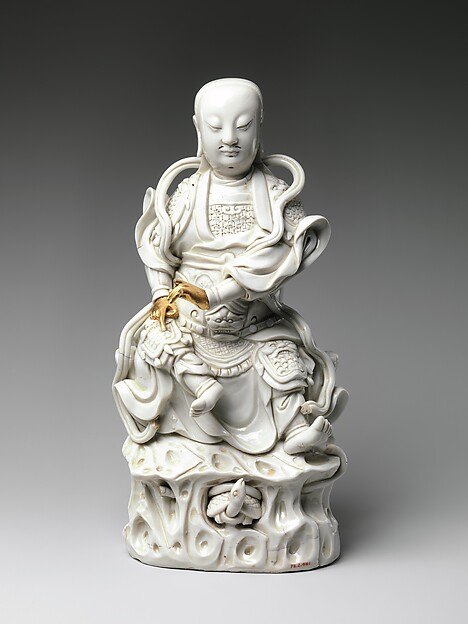
In another, Laozi was a different contemporary of Confucius called Lao Laizi , and wrote a book in 15 parts. The story tells of Zong the Warrior who defeats an enemy and triumphs, and then abandons the corpses of the enemy soldiers to be eaten by vultures. By coincidence Laozi, traveling and teaching the way of the Tao, comes on the scene and is revealed to be the father of Zong, from whom he was separated in childhood. Laozi tells his son that it is better to treat respectfully a beaten enemy, and that the disrespect to their dead would cause his foes to seek revenge. Convinced, Zong orders his soldiers to bury the enemy dead. Funeral mourning is held for the dead of both parties and a lasting peace is made.
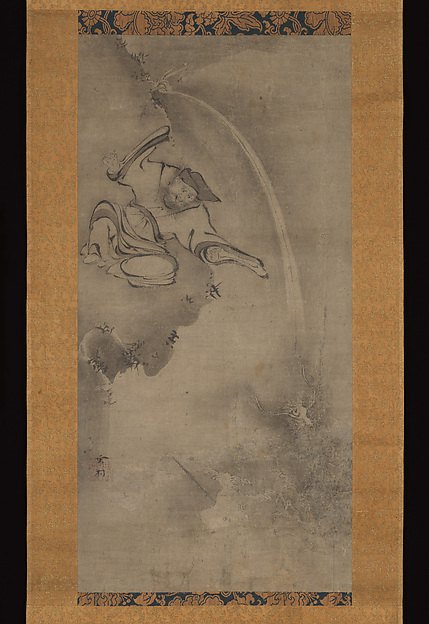
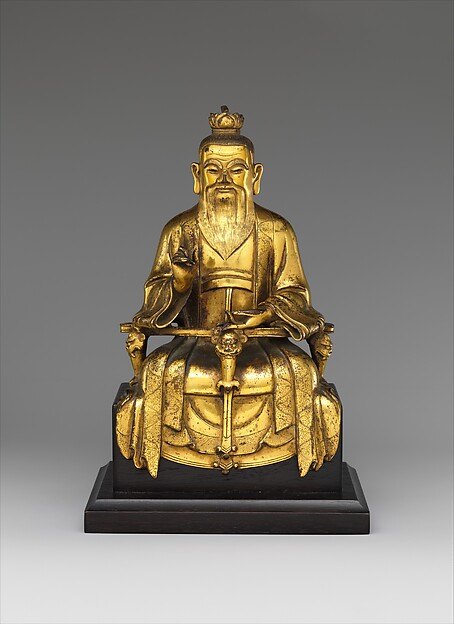
In a third, he was the court astrologer Lao Dan who lived during the 4th centuryBC reign of the Duke Xian of Qin who grew weary of the moral decay of life in Chengzhou and noted the kingdom's decline. He ventured west to live as a hermit in the unsettled frontier at the age of 80. At the western gate of the city (or kingdom), he was recognized by the guard Yinxi. The sentry asked the old master to record his wisdom for the good of the country before he would be permitted to pass. The text Laozi wrote was said to be the Tao Te Ching, although the present version of the text includes additions from later periods. In some versions of the tale, the sentry was so touched by the work that he became a disciple and left with Laozi, never to be seen again. In some later interpretations, the "Old Master" journeyed all the way to India and was the teacher of Siddartha Gautama, the Buddha. Others say he was the Buddha himself.
The stories assert that Laozi never opened a formal school but nonetheless attracted a large number of students and loyal disciples. There are many variations of a story retelling his encounter with Confucius, most famously in the Zhuangzi. His birthday is popularly held to be the 15th day of the second month of the Chinese calendar. In accounts where Laozi married, he was said to have had a son who became a celebrated soldier of Wei during the Warring States period.
Tao Te Ching
The Tao Te Ching is one of the most significant treatises in Chinese cosmogony. It is often called the Laozi, and has always been associated with that name. The identity of the person or people who wrote or compiled the text has been the source of considerable speculation and debate throughout history. As with many works of ancient Chinese philosophy, ideas are often explained by way of paradox, analogy, appropriation of ancient sayings, repetition, symmetry, rhyme, and rhythm. The Tao Te Ching stands as an exemplar of this literary form. Unlike most works of its genre, the book conspicuously lacks a central "master" character and seldom references historical people or events, giving it an air of timelessness.
The Tao Te Ching describes the Tao as the source and ideal of all existence: it is unseen, but not transcendent, immensely powerful yet supremely humble, being the root of all things. People have desires and free will (and thus are able to alter their own nature). Many act "unnaturally", upsetting the natural balance of the Tao. The Tao Te Ching intends to lead students to a "return" to their natural state, in harmony with Tao. Language and conventional wisdom are critically assessed. Taoism views them as inherently biased and artificial, widely using paradoxes to sharpen the point.
Wu wei , literally "non-action" or "not acting", is a central concept of the Tao Te Ching. The concept of wu wei is multifaceted, and reflected in the words' multiple meanings, even in English translation; it can mean "not doing anything", "not forcing", "not acting" in the theatrical sense, "creating nothingness", "acting spontaneously", and "flowing with the moment".
This concept is used to explain ziran , or harmony with the Tao. It includes the concepts that value distinctions are ideological and seeing ambition of all sorts as originating from the same source. Laozi used the term broadly with simplicity and humility as key virtues, often in contrast to selfish action. On a political level, it means avoiding such circumstances as war, harsh laws and heavy taxes. Some Taoists see a connection between wu wei and esoteric practices, such as zuowang (; "sitting in oblivion": emptying the mind of bodily awareness and thought) found in the Zhuangzi.
Alan Chan provides an example of how Laozi encouraged a change in approach, or return to "nature", rather than action. Technology may bring about a false sense of progress. The answer provided by Laozi is not the rejection of technology, but instead seeking the calm state of wu wei, free from desires. This relates to many statements by Laozi encouraging rulers to keep their people in "ignorance", or "simple-minded". Some scholars insist this explanation ignores the religious context, and others question it as an apologetic of the philosophical coherence of the text. It would not be unusual political advice if Laozi literally intended to tell rulers to keep their people ignorant. However, some terms in the text, such as "valley spirit" (, gushen) and "soul" (, po), bear a metaphysical context and cannot be easily reconciled with a purely ethical reading of the work.
Background reading selected and abridged from Laozi by Wikipedia contributors (November 2023 edition), under CC BY-SA 4.0. The linked histories identify contributing authors.