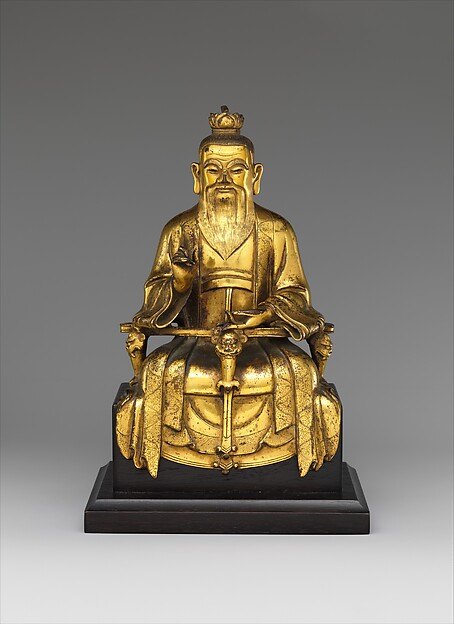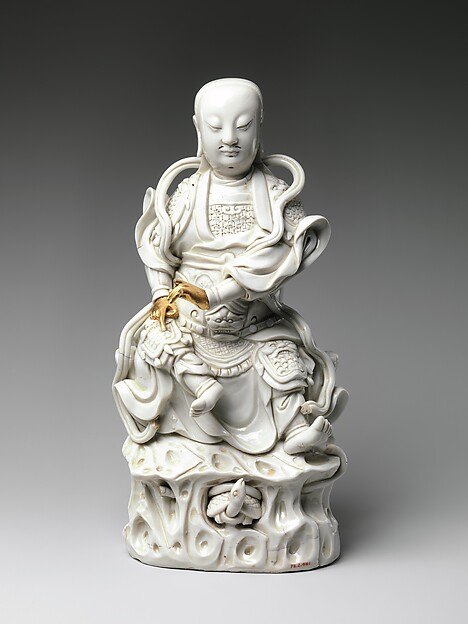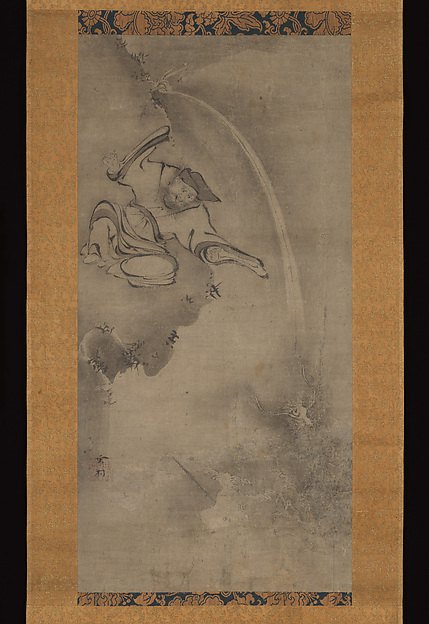
The Ch'uan Ch'en school of Taoism had a variety of definitions about what xian means during its history, including a metaphorical meaning where the term simply means a good, principled person.
Xian (Taoism)
The word xian
The Ch'uan Ch'en school of Taoism had a variety of definitions about what xian means during its history, including a metaphorical meaning where the term simply means a good, principled person.
The character and its variants
The word xiān is written with three characters 僊, 仙, or 仚, which combine the logographic "radical" rén ( or "person; human") with two "phonetic" elements (see Chinese character classification). The oldest recorded xiān character has a xiān ("rise up; ascend") phonetic supposedly because immortals could "ascend into the heavens". (Compare qiān "move; transfer; change" combining this phonetic and the motion radical.) The usual modern xiān character , and its rare variant , have a shān ( "mountain") phonetic. For a character analysis, Schipper interprets "'the human being of the mountain,' or alternatively, 'human mountain'. The two explanations are appropriate to these beings: they haunt the holy mountains, while also embodying nature."
The Classic of Poetry (220/3) contains the oldest occurrence of the character , reduplicated as xiānxiān ( "dance lightly; hop about; jump around"), and rhymed with qiān . "But when they have drunk too much, Their deportment becomes light and frivolous—They leave their seats, and [] go elsewhere, They keep [] dancing and capering." (tr. James Legge) Needham and Wang suggest xian was cognate with wu "shamanic" dancing. Paper writes, "the function of the term xian in a line describing dancing may be to denote the height of the leaps. Since, "to live for a long time" has no etymological relation to xian, it may be a later accretion."
The 121 CE Shuowen Jiezi, the first important dictionary of Chinese characters, does not enter except in the definition for ( "name of an ancient immortal"). It defines as "live long and move away" and as "appearance of a person on a mountaintop".
Textual references
Early text such as Zhuangzi, Chuci, and Liezi texts allegorically used xian immortals and magic islands to describe spiritual immortality, sometimes using the word yuren or "feathered person" (later another word for "Daoist" ), and were described with motifs of feathers and flying.
Later texts like the Shenxian zhuan and Baopuzi took immortality literally and described esoteric Chinese alchemical techniques for physical longevity, with techniques such as neidan ( "internal alchemy") and waidan ( "external alchemy").
Neidan ( "internal alchemy") techniques included taixi ( "embryonic respiration") breath control, meditation, visualization, sexual training, and Tao Yin exercises (which later evolved into qigong and tai chi chuan), while waidan ( "external alchemy") techniques for immortality included alchemical recipes, magic plants, rare minerals, herbal medicines, drugs, and dietetic techniques like inedia.
Besides the following major Chinese texts, many others use both graphic variants of xian. Xian occurs in the Chunqiu Fanlu, Fengsu Tongyi, Qian fu lun, Fayan, and Shenjian; xian occurs in the Caizhong langji, Fengsu Tongyi, Guanzi, and Shenjian.
They are usually found in Taoist texts, although some Buddhist sources mention them. Chinese folk religion and writings on it also use them, such as in Northeast China with the fox gods or "huxian" common in the region.
During the Six Dynasties, xian were a common subject of zhiguai stories. They often had "magical" Tao powers including the abilities to "walk...through walls or stand...in light without casting a shadow."
Zhuangzi
Without using the word xian, several Zhuangzi passages employ xian imagery, like flying in the clouds, to describe individuals with superhuman powers. For example, Chapter 1, within the circa 3rd century BCE "Inner Chapters", has two portrayals. First is this description of Liezi (below).
The authors of the Zhuangzi had a lyrical view of life and death, seeing them as complementary aspects of natural changes. This is antithetical to the physical immortality (changshengbulao "live forever and never age") sought by later Daoist alchemists. Consider this famous passage about accepting death.
Chuang Tzu's wife died. When Hui Tzu went to convey his condolences, he found Chuang Tzu sitting with his legs sprawled out, pounding on a tub and singing. "You lived with her, she brought up your children and grew old," said Hui Tzu. "It should be enough simply not to weep at her death. But pounding on a tub and singing—this is going too far, isn't it?"
Many conclusions can be reached on the basis of this story, but it seems that death is regarded as a natural part of the ebb and flow of transformations which constitute the movement of Dao. To grieve over death, or to fear one's own death, for that matter, is to arbitrarily evaluate what is inevitable. Of course, this reading is somewhat ironic given the fact that much of the subsequent Daoist tradition comes to seek longevity and immortality, and bases some of their basic models on the Zhuangzi.
Chuci
The 3rd–2nd century BCE Chuci ( "Lyrics of Chu") anthology of poems uses xian once and xian twice, reflecting the disparate origins of the text. These three contexts mention the legendary Daoist xian immortals Chi Song ( "Red Pine", and Wang Qiao (, or Zi Qiao ). In later Daoist hagiography, Chi Song was Lord of Rain under Shennong, the legendary inventor of agriculture; and Wang Qiao was a son of King Ling of Zhou (r. 571–545 BCE), who flew away on a giant white bird, became an immortal and was never again seen.
Background reading selected and abridged from Xian (Taoism) by Wikipedia contributors (November 2023 edition), under CC BY-SA 4.0. The linked histories identify contributing authors.