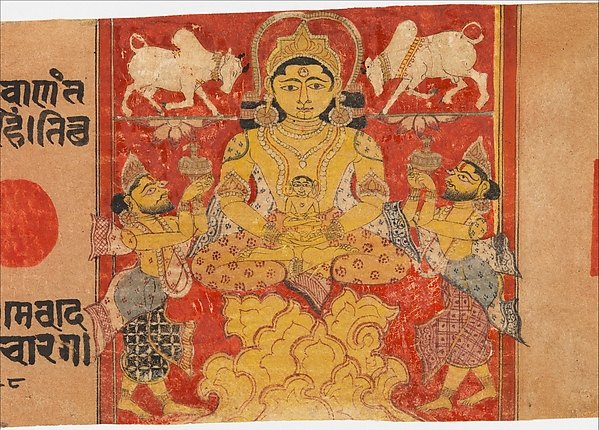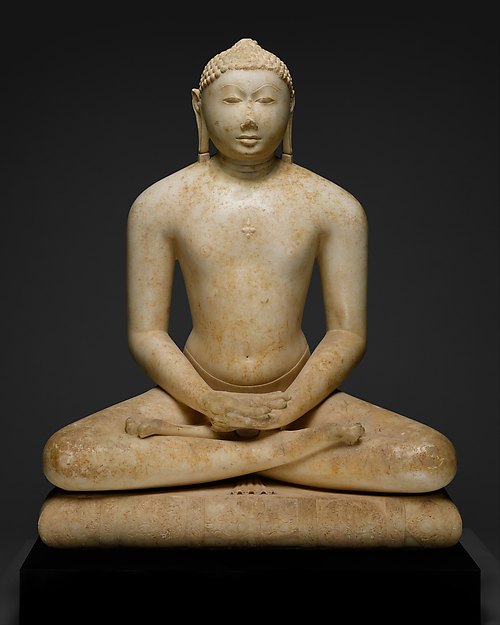
Digambara (; "sky-clad") is one of the two major schools of Jainism, the other being Śvētāmbara (white-clad).
Digambara
Digambara (; "sky-clad") is one of the two major schools of Jainism, the other being Śvētāmbara (white-clad). The Sanskrit word Digambara means "sky-clad", referring to their traditional monastic practice of neither possessing nor wearing any clothes.
Digambara and Śvētāmbara traditions have had historical differences ranging from their dress code, their temples and iconography, attitude towards female monastics, their legends, and the texts they consider as important.
Digambara monks cherish the virtue of non-attachment and non-possession of any material goods. Monks carry a community-owned picchi, which is a broom made of fallen peacock feathers for removing and thus saving the life of insects in their path or before they sit.
The Digambara literature can be traced only to the first millennium, with its oldest surviving sacred text being the mid-second century Ṣaṭkhaṅḍāgama "Scripture in Six Parts" of Dharasena (the Moodabidri manuscripts). One of the most important scholar-monks of the Digambara tradition was Kundakunda.
Digambara Jain communities are currently found mainly in most parts of North India in states like Rajasthan, Uttar Pradesh, Delhi, Bihar, Jharkhand, Madhya Pradesh, parts of south Maharashtra and Karnataka. According to Jeffery D. Long, a scholar of Hindu and Jain studies, less than one fifth of all Jains in India have a Digambara heritage.
Nomenclature
According to Heinrich Zimmer, the word Digambara is a combination of two Sanskrit words: dik (दिक्) (space, sky) and ambara (अम्बर) (garment), referring to those whose garments are of the element that fills the four quarters of space.
Origin in traditional accounts
The Digambaras and Svetambaras disagree on how the Digambara subtradition started in Jainism. According to Digambaras, they are the original followers of Mahavira and Svetambaras branched off later in the time of Bhadrabahu when their forecasted twelve-year famine triggered their migration from central India. One group of Jain monks headed west and north towards Rajasthan, while the second group headed south towards Karnataka. The former became Svetambaras and retained their "heretic" beliefs and practices such as wearing "white clothes" they adopted there, say the Digambaras. In contrast, according to Svetambaras, they are the original followers, and Digambaras arose 609 years after the death of Mahavira (about 1st century CE) because of an arrogant man named Sivabhuti who became a Jain monk in a fit of pique after a fight at home. He is accused of starting the Digambara Jain tradition with what Svetambara call as "eight concealments", of rejecting Jain texts preserved by the Svetambara tradition, and misunderstanding the Jain ideology including those related to nuns and clothes. Neither of these explanations can be found in early Jain or non-Jain texts. The earliest version of this Digambara story appears in the 10th century CE, while the earliest version of the Svetambara story appears in the 5th century CE.
History
In 1943, Heinrich Zimmer proposed that the Greek records of 4th-century BCE mention gymnosophists (naked philosophers) which may have links to the tradition of "nude ascetics" claimed by the Digambaras. In 2011, Patrick Olivelle stated that the context in which the Greek records mention gymnosophists include ritual suicide by cremation traceable to ancient Brahmanism, rather than the traditional Jain ritual of embracing death by starvation and taking samadhi by voluntarily sacrificing everything including food and water (sallekhana). Dundas talks about the archeological evidences which indicate that Jain monks moved from the practice of total nudity towards wearing clothes in later period. Tirthankara statues found in Mathura and dated to 2nd-century CE or after are naked. The oldest Tirthankara statue wearing a cloth is dated in 5th century CE. Digamabara statues of tirthankara belonging to Gupta period has half-closed eyes.
In 17th-century, adhyatma movement in Agra led to rise of terapanthi and bisapanthi sub-sects based on the differences over acceptance of authority of bhattarakas. King Jai Singh II (1688–1743) of Amer kingdom built separate temples for the two sub-sects in his newly established capital of Jaipur. Terapanthis, led by scholars like Pandit Todarmal and Banarasidas, rejected the authority of bhattarakas.
Lineage
According to Digambara texts, after liberation of Mahavira, three Anubaddha Kevalīs attained Kevalajñāna (omniscience) sequentially – Gautama Gaņadhara, Acharya Sudharma Swami, and Jambusvami in next 62 years. During the next hundred years, five Āchāryas had complete knowledge of the scriptures, as such, called Śruta Kevalīs, the last of them being Āchārya Bhadrabahu. Spiritual lineage of heads of monastic orders is known as Pattavali. Digambara tradition consider Dharasena to be the 33rd teacher in succession of Gautama, 683 years after the nirvana of Mahavira.
In the Digambara tradition, the following lineage of teachers are revered: Mahavira, Gautama, Kundakunda, Bhadrabahu, Umaswami, Samantabhadra, Siddhasena Divakara, Pujyapada, Manatunga, Virasena, Jinasena, Nemichandra. Kundakunda is considered the most significant scholar monk of the Digambara tradition of Jainism. He authored Prakrit texts such as the Samayasāra and the Pravacanasāra. Other prominent Acharyas of this tradition were, Virasena (author of a commentary on the Dhavala), Samantabhadra and Siddhasena Divakara. The Satkhandagama and Kasayapahuda have major significance in the Digambara tradition.
There have been several Digambara monastic lineages that all trace their descent to Mahavira. The historical linages included Mula Sangha (further vivided into Nandi, Sena, Simha and Deva Sanghas) and now largely extinct Kashtha Sangha (which included Mathura sangha, ""Lat-Vagad" etc.), Dravida Sangh. The text Darshana-Sara of Devasena discusses the supposed differences among the orders. The Mula sangha orders include Deshiya Gana (Bhattarakas of Shravanabelgola etc.) and Balatkara Gana (Bhattarakas of Humcha, and numerous linages of North/Central India) traditions. The Bhattarakas of Shravanabelagola and Mudbidri belong to Deshiya Gana and the Bhattaraka of Humbaj belongs to the Balatkara Gana.
Background reading selected and abridged from Digambara by Wikipedia contributors (November 2023 edition), under CC BY-SA 4.0. The linked histories identify contributing authors.