As jmy-wt (Imiut or the Imiut fetish) "He who is in the place of embalming", Anubis was associated with mummification.
Anubis
Embalmer
As jmy-wt (Imiut or the Imiut fetish) "He who is in the place of embalming", Anubis was associated with mummification. He was also called ḫnty zḥ-nṯr "He who presides over the god's booth", in which "booth" could refer either to the place where embalming was carried out or the pharaoh's burial chamber.
In the Osiris myth, Anubis helped Isis to embalm Osiris. Indeed, when the Osiris myth emerged, it was said that after Osiris had been killed by Set, Osiris's organs were given to Anubis as a gift. With this connection, Anubis became the patron god of embalmers; during the rites of mummification, illustrations from the Book of the Dead often show a wolf-mask-wearing priest supporting the upright mummy.
Protector of tombs
Anubis was a protector of graves and cemeteries. Several epithets attached to his name in Egyptian texts and inscriptions referred to that role. Khenty-Amentiu, which means "foremost of the westerners" and was also the name of a different canine funerary god, alluded to his protecting function because the dead were usually buried on the west bank of the Nile. He took other names in connection with his funerary role, such as tpy-ḏw.f (Tepy-djuef) "He who is upon his mountain" (i.e. keeping guard over tombs from above) and nb-t3-ḏsr (Neb-ta-djeser) "Lord of the sacred land", which designates him as a god of the desert necropolis.
The Jumilhac papyrus recounts another tale where Anubis protected the body of Osiris from Set. Set attempted to attack the body of Osiris by transforming himself into a leopard. Anubis stopped and subdued Set, however, and he branded Set's skin with a hot iron rod. Anubis then flayed Set and wore his skin as a warning against evil-doers who would desecrate the tombs of the dead. Priests who attended to the dead wore leopard skin in order to commemorate Anubis' victory over Set. The legend of Anubis branding the hide of Set in leopard form was used to explain how the leopard got its spots.
Guide of souls
By the late pharaonic era (664–332 BC), Anubis was often depicted as guiding individuals across the threshold from the world of the living to the afterlife. Though a similar role was sometimes performed by the cow-headed Hathor, Anubis was more commonly chosen to fulfill that function. Greek writers from the Roman period of Egyptian history designated that role as that of "psychopomp", a Greek term meaning "guide of souls" that they used to refer to their own god Hermes, who also played that role in Greek religion. Funerary art from that period represents Anubis guiding either men or women dressed in Greek clothes into the presence of Osiris, who by then had long replaced Anubis as ruler of the underworld.
Weigher of hearts
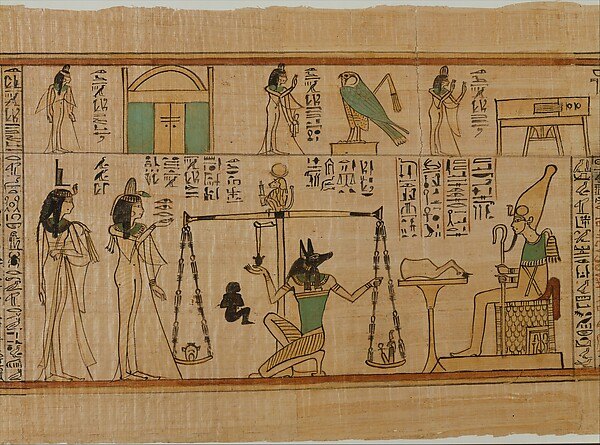
One of the roles of Anubis was as the "Guardian of the Scales." The critical scene depicting the weighing of the heart, in the Book of the Dead, shows Anubis performing a measurement that determined whether the person was worthy of entering the realm of the dead (the underworld, known as Duat). By weighing the heart of a deceased person against ma'at, who was often represented as an ostrich feather, Anubis dictated the fate of souls. Souls heavier than a feather would be devoured by Ammit, and souls lighter than a feather would ascend to a heavenly existence.
Portrayal in art
Anubis was one of the most frequently represented deities in ancient Egyptian art. He is depicted in royal tombs as early as the First Dynasty. The god is typically treating a king's corpse, providing sovereign to mummification rituals and funerals, or standing with fellow gods at the Weighing of the Heart of the Soul in the Hall of Two Truths. One of his most popular representations is of him, with the body of a man and the head of a jackal with pointed ears, standing or kneeling, holding a gold scale while a heart of the soul is being weighed against Ma'at's white truth feather.
In the early dynastic period, he was depicted in animal form, as a black canine. Anubis's distinctive black color did not represent the animal, rather it had several symbolic meanings. It represented "the discolouration of the corpse after its treatment with natron and the smearing of the wrappings with a resinous substance during mummification." Being the color of the fertile silt of the River Nile, to Egyptians, black also symbolized fertility and the possibility of rebirth in the afterlife. In the Middle Kingdom, Anubis was often portrayed as a man with the head of a jackal. The African jackal was the species depicted and the template of numerous Ancient Egyptian deities, including Anubis. An extremely rare depiction of him in fully human form was found in a chapel of Ramesses II in Abydos.
Anubis is often depicted wearing a ribbon and holding a nḫ3ḫ3 "flail" in the crook of his arm. Another of Anubis's attributes was the jmy-wt or imiut fetish, named for his role in embalming. In funerary contexts, Anubis is shown either attending to a deceased person's mummy or sitting atop a tomb protecting it. New Kingdom tomb-seals also depict Anubis sitting atop the nine bows that symbolize his domination over the enemies of Egypt.
Background reading selected and abridged from Anubis by Wikipedia contributors (November 2023 edition), under CC BY-SA 4.0. The linked histories identify contributing authors.