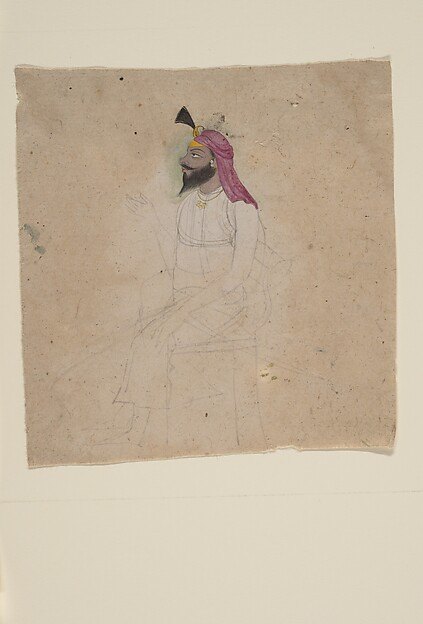
Guru Gobind Singh (; born Gobind Das; 22 December 1666 – 7 October 1708) was the tenth and last human Sikh Guru.
Guru Gobind Singh
Guru Gobind Singh (; born Gobind Das; 22 December 1666 – 7 October 1708) was the tenth and last human Sikh Guru. He was a warrior, poet, and philosopher. In 1675, at the age of nine he was formally installed as the leader of the Sikhs after his father Guru Tegh Bahadur was executed by Emperor Aurangzeb. His four biological sons died during his lifetime – two in battle and two executed by the Mughal governor Wazir Khan.
Among his notable contributions to Sikhism are founding the Sikh warrior community called Khalsa in 1699 and introducing the Five Ks, the five articles of faith that Khalsa Sikhs wear at all times. Guru Gobind Singh is credited with the Dasam Granth whose hymns are a sacred part of Sikh prayers and Khalsa rituals. He is also credited as the one who finalized and enshrined the Guru Granth Sahib as Sikhism's primary scripture and the eternal Guru.
Family and early life
Gobind Singh was the only son of Guru Tegh Bahadur, the ninth Sikh guru, and Mata Gujri. He was born into the Sodhi clan of the Punjabi Khatri community. He was born in Patna, Bihar on 22 December 1666 while his father was visiting Bengal and Assam. His birth name was Gobind Das, and a shrine named Takht Sri Patna Harimandar Sahib marks the site of the house where he was born and spent the first four years of his life. In 1670, his family returned to Punjab, and in March 1672, they moved to Chakk Nanaki in the Himalayan foothills of north India, called the Sivalik range, where he was schooled.
Tegh Bahadur was petitioned by Kashmiri Pandits in 1675 for protection from the fanatic persecution by Iftikar Khan, the Mughal governor of Kashmir under Mughal Emperor Aurangzeb. Tegh Bahadur considered a peaceful resolution by meeting Aurangzeb, but was cautioned by his advisors that his life may be at risk. The young Gobind Das – to be known as Gobind Singh after 1699 – advised his father that no one was more worthy to lead and make a sacrifice than him. His father made the attempt, but was arrested then publicly beheaded in Delhi on 11 November 1675 under the orders of Aurangzeb for refusing to convert to Islam and the ongoing conflicts between Sikhism and the Islamic Empire. Before dying, Tegh Bahadur wrote a letter to Gobind Das (the letter was called Mahalla Dasven and it is part of the Guru Granth Sahib) as one last test to find the next Guru, after his father's martyrdom he was made the tenth Sikh Guru on Vaisakhi on 29 March 1676.
The education of Gobind Singh continued after he became the 10th Guru, both in reading and writing as well as martial arts such as horse riding and archery. The Guru learned Farsi in a year and at the age of 6 started training in martial arts. In 1684, he wrote the Chandi di Var in Punjabi language – a legendary war between the good and the evil, where the good stands up against injustice and tyranny, as described in the ancient Sanskrit text Markandeya Purana. He stayed in Paonta, near the banks of river Yamuna, until 1685.
Guru Gobind Singh had three wives:
At age 10, he married Jito on 21 June 1677 at Basantgaṛh, 10 km north of Anandpur. The couple had three sons: Jujhar Singh (b. 1691), Zorawar Singh (b. 1696), and Fateh Singh (b. 1699).
At age 33, he married Sahib Devan on 15 April 1700 at Anandpur. They had no children, but she had an influential role in Sikhism. Guru Gobind Singh proclaimed her as the Mother of the Khalsa. The Guru initially rejected her marriage proposal as he was already married and had four sons. The Sangat and the Guru's family agreed to the marriage. However, Gobind Singh made it clear that his relationship with Sahib Diwan will be spiritual and not physical.
The life example and leadership of Gobind Singh have been of historical importance to the Sikhs. He institutionalized the Khalsa (literally, Pure Ones), who played the key role in protecting the Sikhs long after his death, such as during the nine invasions of Panjab and the attacks by Ahmad Shah Abdali from Afghanistan between 1747 and 1769.
Founding the Khalsa
In 1699, Guru Gobind Singh requested the Sikhs to congregate at Anandpur on Vaisakhi (the annual spring harvest festival). According to the Sikh tradition, he asked for a volunteer. One came forward, whom he took inside a tent. The Guru returned to the crowd alone, with a bloody sword. He asked for another volunteer, and repeated the same process of returning from the tent without anyone and with a bloodied sword four more times. After the fifth volunteer went with him into the tent, the Guru returned with all five volunteers, all safe. He called them the Panj Pyare and the first Khalsa in the Sikh tradition.
Gobind Singh then mixed water and sugar into an iron bowl, stirring it with a double-edged sword to prepare what he called Amrit ("nectar"). He then administered this to the Panj Pyare, accompanied with recitations from the Adi Granth, thus founding the khande ka pahul (baptization ceremony) of a Khalsa – a warrior community. The Guru also gave them a new surname "Singh" (lion). After the first five Khalsa had been baptized, the Guru asked the five to baptize him as a Khalsa. This made the Guru the sixth Khalsa, and his name changed from Guru Gobind Das to Guru Gobind Singh. This initiation ceremony replaced the charan pahul ritual practiced by the previous gurus, in which an initiate would drink the water either the Guru or a masand of the guru had dipped their right toe in.
Background reading selected and abridged from Guru Gobind Singh by Wikipedia contributors (November 2023 edition), under CC BY-SA 4.0. The linked histories identify contributing authors.