The Guru Granth Sahib (, ) is the central holy religious scripture of Sikhism, regarded by Sikhs as the final, sovereign and eternal Guru following the lineage of the ten human gurus of the religion.
Guru Granth Sahib
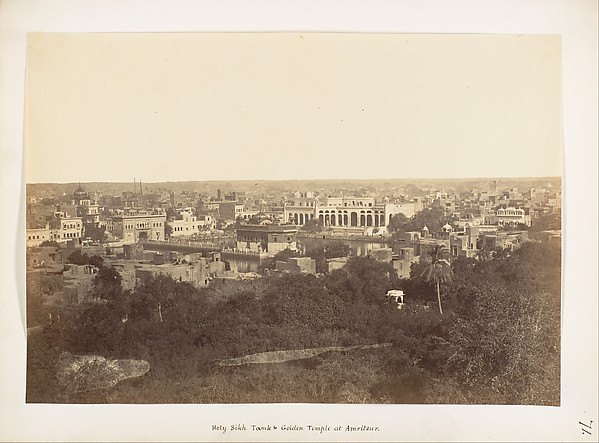
The Guru Granth Sahib (, ) is the central holy religious scripture of Sikhism, regarded by Sikhs as the final, sovereign and eternal Guru following the lineage of the ten human gurus of the religion. The Adi Granth , its first rendition, was compiled by the fifth guru, Guru Arjan (1564–1606). Its compilation was completed on 29 August 1604 and first installed inside Golden Temple in Amritsar on 1 September 1604. Baba Buddha was appointed the first Granthi of the Golden Temple. Shortly afterwards Guru Hargobind added Ramkali Ki Vaar. Later, Guru Gobind Singh, the tenth Sikh guru, added hymns of Guru Tegh Bahadur to the Adi Granth and affirmed the text as his successor. This second rendition became known as the Guru Granth Sahib and is also sometimes referred to as the Adi Granth.
The text consists of 1,430 angs (pages) and 5,894 shabads (line compositions), which are poetically rendered and set to a rhythmic ancient north Indian classical form of music. The bulk of the scripture is divided into 31 main rāgas, with each Granth rāga subdivided according to length and author. The hymns in the scripture are arranged primarily by the rāgas in which they are read. The Guru Granth Sahib is written in the Gurmukhi script in various languages including Punjabi, Lahnda, regional Prakrits, Apabhramsa, Sanskrit, Hindi languages (Braj Bhasha, Bangru, Awadhi, Old Hindi), Bhojpuri, Sindhi, Marathi, Marwari, Bengali, Persian and Arabic. Copies in these languages often have the generic title of Sant Bhasha.
The Guru Granth Sahib was composed predominantly by six Sikh gurus: Guru Nanak, Guru Angad, Guru Amar Das, Guru Ram Das, Guru Arjan and Guru Tegh Bahadur. It also contains the traditions and teachings of fourteen Hindu Bhakti movement sants (saints), such as Ramananda, Kabir and Namdev among others, and one Muslim Sufi saint: Sheikh Farid.
The vision in the Guru Granth Sahib is of a society based on divine freedom, mercy, love and justice without oppression of any kind. While the Granth acknowledges and respects the scriptures of Hinduism and Islam, it does not imply a moral reconciliation with either of these religions. It is installed in a Sikh gurdwara (temple). A Sikh typically prostrates before it on entering such a temple. The Granth is revered as eternal gurbānī and the spiritual authority in Sikhism.
History
Guru Nanak composed hymns, which were sung by his followers in rāga set to music. His successor, Guru Angad, opened centers and distributed these hymns. The community would sing the hymns and his agents collected donations. This tradition was continued by the third and fourth gurus as well. The fifth guru, Guru Arjan, discovered that Prithi Chand – his eldest brother and a competing claimant to the Sikh guruship – had a copy of an earlier pothi (palm-leaf manuscript) with hymns and was distributing hymns of the earlier gurus along with his own of hymns. Guru Arjan considered these as spurious and became concerned about establishing an authentic anthology of approved hymns.
Guru Arjan began compiling an officially approved version of the sacred scripture for the Sikh community. He sent his associates across the Indian subcontinent to collect the circulating hymns of Sikh gurus and convinced Mohan, the son of Guru Amar Das, to give him the collection of the religious writings of the first three gurus in a humble manner by singing the hymns registered in Guru Granth Sahib, 248. As his associates returned with their collections, Guru Arjan selected and edited the hymns for inclusion in the Adi Granth with Bhai Gurdas as his scribe. This effort yielded several drafts and manuscripts, some of which have survived into the modern era.
The oldest surviving manuscript version of the Adi Granth is the Guru Nanak Dev University Manuscript 1245, which has been dated to . Other early editions of the Adi Granth with some variations include the Bahoval pothi (c. 1600), Vanjara pothi (c. 1601) and Bhai Rupa pothi (c. 1603).
Another early variant manuscript is called the Guru Harsahai pothi, preserved by Sodhis and is believed to be the one that existed before Guru Arjan's compilation and one he gave to his eldest brother Prithi Chand. It was initially installed in Amritsar, then was moved in the 18th-century and preserved in Guru Harsahai (35 kilometers west of Faridkot, Punjab) till 1969, when the state government requested it be displayed for the 500 years celebrations. It was moved for the first time in over 200 years and briefly displayed in Patiala for the event. Thereafter, the Sodhis consented to transfers. In 1970, however, during another such transfer, this early version of the Adi Granth manuscript was stolen. However, photos of some pages have survived.
This manuscript is claimed by the Sodhis to be the oldest and one written in part by Guru Nanak. However, this claim is first observed only much later, in texts attributed to the 17th-century Hariji, the grandson of Prithi Chand. Based on the evidence in the surviving photos, it is unlikely that Guru Nanak wrote or maintained a pothi. The features in its Gurmukhi script and the language suggest that the hymns are significantly older, and that the pre-canonical hymns were being written down in early Sikhism and preserved by the Sikh Gurus prior to the editing by Guru Arjan. The existence of Guru Harsahai manuscript attests to the early tradition of Sikh scripture, its existence in variant forms and a competition of ideas on its contents including the Mul Mantar.
Background reading selected and abridged from Guru Granth Sahib by Wikipedia contributors (November 2023 edition), under CC BY-SA 4.0. The linked histories identify contributing authors.