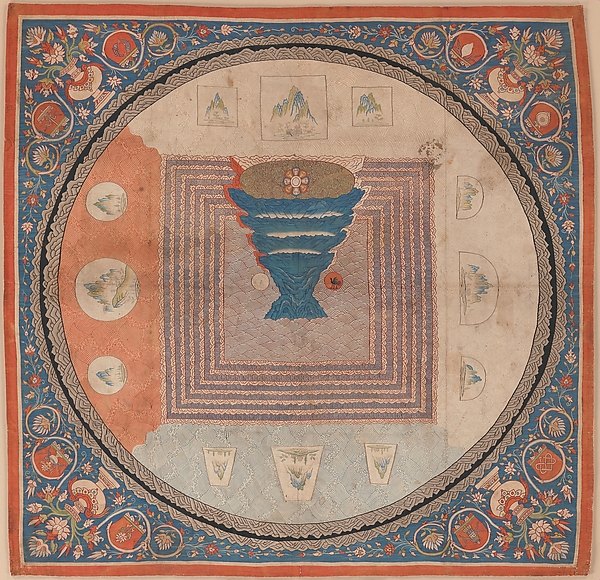
One Japanese branch of Mahayana Buddhism – Shingon Buddhism – makes frequent use of mandalas in its rituals as well, though the actual mandalas differ.
Mandala
Shingon Buddhism
One Japanese branch of Mahayana Buddhism – Shingon Buddhism – makes frequent use of mandalas in its rituals as well, though the actual mandalas differ. When Shingon's founder, Kukai, returned from his training in China, he brought back two mandalas that became central to Shingon ritual: the Mandala of the Womb Realm and the Mandala of the Diamond Realm.
These two mandalas are engaged in the abhiseka initiation rituals for new Shingon students, more commonly known as the . A common feature of this ritual is to blindfold the new initiate and to have them throw a flower upon either mandala. Where the flower lands assists in the determination of which tutelary deity the initiate should follow.
Nichiren Buddhism
The mandala in Nichiren Buddhism is a , which is a paper hanging scroll or wooden tablet whose inscription consists of Chinese characters and medieval-Sanskrit script representing elements of the Buddha's enlightenment, protective Buddhist deities, and certain Buddhist concepts. Called the Gohonzon, it was originally inscribed by Nichiren, the founder of this branch of Japanese Buddhism, during the late 13th Century. The Gohonzon is the primary object of veneration in some Nichiren schools and the only one in others, which consider it to be the supreme object of worship as the embodiment of the supreme Dharma and Nichiren's inner enlightenment. The seven characters Namu Myōhō Renge Kyō, considered to be the name of the supreme Dharma, as well as the invocation that believers chant, are written down the center of all Nichiren-sect Gohonzons, whose appearance may otherwise vary depending on the particular school and other factors.
Pure Land Buddhism
Mandalas have sometimes been used in Pure Land Buddhism to graphically represent Pure Lands, based on descriptions found in the Larger Sutra and the Contemplation Sutra. The most famous mandala in Japan is the Taima mandala, dated to about 763 CE. The Taima mandala is based on the Contemplation Sutra, but other similar mandalas have been made subsequently. Unlike mandalas used in Vajrayana Buddhism, it is not used as an object of meditation or for esoteric ritual. Instead, it provides a visual representation of the Pure Land texts, and is used as a teaching aid.
Also in Jodo Shinshu Buddhism, Shinran and his descendant, Rennyo, sought a way to create easily accessible objects of reverence for the lower-classes of Japanese society. Shinran designed a mandala using a hanging scroll, and the words of the nembutsu written vertically. This style of mandala is still used by some Jodo Shinshu Buddhists in home altars, or butsudan.
Sand mandalas
Sand mandalas are colorful mandalas made from sand that are ritualistically destroyed. They originated in India in the 8th-12th century but are now practiced in Tibetan Buddhism. Each mandala is dedicated to specific deities. In Buddhism Deities represent states of the mind to be obtained on the path to enlightenment, the mandala itself is representative of the deities palace which also represents the mind of the deity. Each mandala is a pictorial representation of a tantra. for the process of making Sand mandalas they are created by monks that have trained for 3-5 years in a monastery. These sand mandalas are made to be destroyed to symbolize impermanence, the Buddhist belief that death is not the end, and that one's essence will always return to the elements. It is also related to the belief that one should not become attached to anything. To create these mandalas, the monks first create a sketch, then take colorful sand traditionally made from powdered stones and gems into copper funnels called Cornetts and gently tap sand out of them to create the sand mandala. Each color represents attributes of deities. While making the mandalas the monks will pray and meditate, each grain of sand represents a blessing. Monks will travel to demonstrate this art form to people, often in museums.
Mayan Tzolk'in
The Maya civilization tended to present calendars in a form similar to a mandala. It is similar in form and function to the Kalachakra (Wheel of Time) sand paintings of Tibetan Buddhists. Maya symbolism was later used in the Dreamspell calendar, developed by José Argüelles. Sometimes described as an authentic Mayan mandala, it is "inspired by" elements of the 260-day Tzolk'in calendar (as opposed to the 365-day Haabʼ calendar).
Aztec Sun Stone
The Sun Stone is thought to be a ceremonial representation of the entire universe as seen by the Aztec religious class, in some ways resembling a mandala.
The earliest interpretations of the stone relate to its use as a calendar. In 1792, two years after the stone's unearthing, Mexican anthropologist Antonio de León y Gama wrote a treatise on the Aztec calendar using the stone as its basis. Some of the circles of glyphs are the glyphs for the days of the month. The four symbols included in the Ollin glyph represent the four past suns that the Mexica believed the earth had passed through.
Another aspect of the stone is its religious significance. One theory is that the face at the center of the stone represents Tonatiuh, the Aztec deity of the sun; it is for this reason that the stone became known as the "Sun Stone." Richard Townsend proposed a different theory, claiming that the figure at the center of the stone represents Tlaltecuhtli, the Mexica earth deity who features in Mexica creation myths. Modern archaeologists, such as those at the National Anthropology Museum in Mexico City, believe it is more likely to have been used primarily as a ceremonial basin or ritual altar for gladiatorial sacrifices than as an astrological or astronomical reference.
Background reading selected and abridged from Mandala by Wikipedia contributors (November 2023 edition), under CC BY-SA 4.0. The linked histories identify contributing authors.