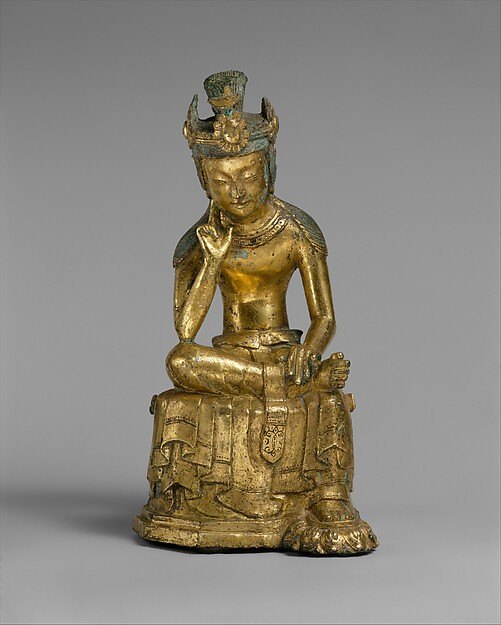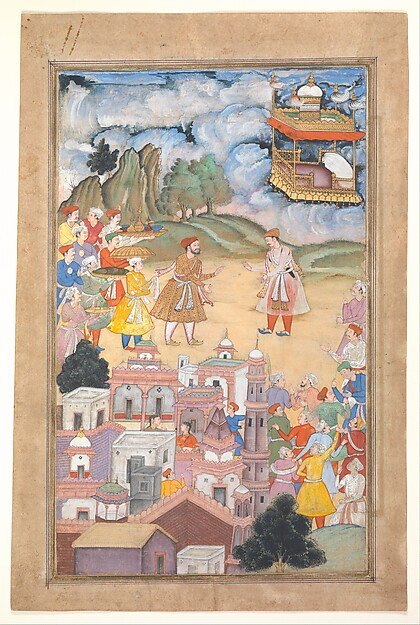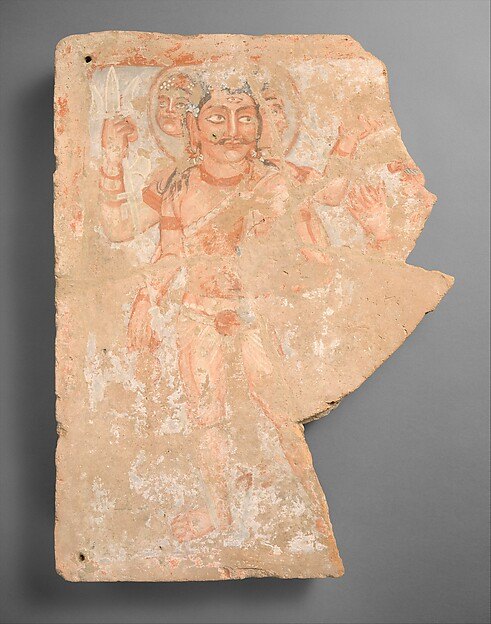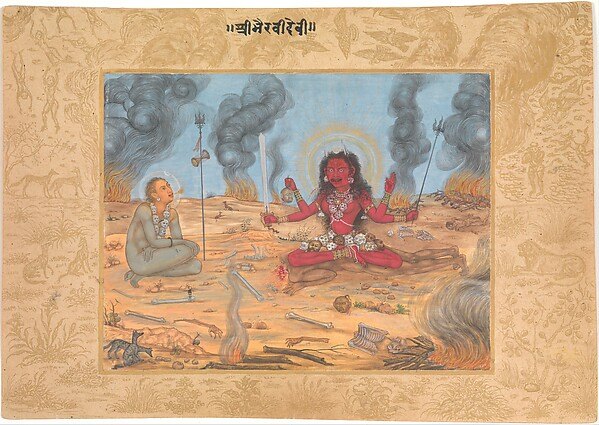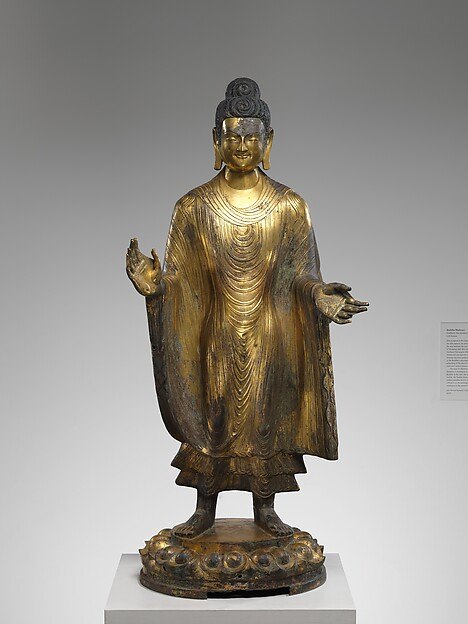
Buddhist art is visual art produced in the context of Buddhism.
Buddhist art
Buddhist art is visual art produced in the context of Buddhism. It includes depictions of Gautama Buddha and other Buddhas and bodhisattvas, notable Buddhist figures both historical and mythical, narrative scenes from their lives, mandalas, and physical objects associated with Buddhist practice, such as vajras, bells, stupas and Buddhist temple architecture. Buddhist art originated in the north of the Indian subcontinent, in modern India, Pakistan and Afghanistan, with the earliest survivals dating from a few centuries after the historical life of Siddhartha Gautama from the 6th to 5th century BCE.
As Buddhism spread and evolved in each new host country, Buddhist art followed in its footsteps. It developed to the north through Central Asia and into Eastern Asia to form the Northern branch of Buddhist art, and to the east as far as Southeast Asia to form the Southern branch of Buddhist art. In India, Buddhist art flourished and co-developed with Hindu and Jain art, with cave temple complexes built together, each likely influencing the other.
Initially the emphasis was on devotional statues of the historical Buddha, as well as detailed scenes in relief of his life, and former lives, but as the Buddhist pantheon developed devotional images of bodhisattvas and other figures became common subjects in themselves in Northern Buddhist art, rather than just attendants of the Buddha, and by the late first millennium came to predominate.
Pre-iconic phase (5th–1st century BCE)
During the 2nd to 1st century BCE, sculptures became more explicit, representing episodes of the Buddha's life and teachings. These took the form of votive tablets or friezes, usually in relation to the decoration of stupas.
Although India had a long sculptural tradition and a mastery of rich iconography, the Buddha was never represented in human form, but only through Buddhist symbolism. This period may have been aniconic.
Artists were reluctant to depict the Buddha anthropomorphically, and developed sophisticated aniconic symbols to avoid doing so (even in narrative scenes where other human figures would appear). This tendency remained as late as the 2nd century CE in the southern parts of India, in the art of the Amaravati School (see: Mara's assault on the Buddha).
It has been argued that earlier anthropomorphic representations of the Buddha may have been made of wood and may have perished since then. However, no related archaeological evidence has been found.
Iconic phase (1st century CE – present)
Chinese historical sources and mural paintings in the Tarim Basin city of Dunhuang accurately describe the travels of the explorer and ambassador Zhang Qian to Central Asia as far as Bactria around 130 BCE, and the same murals describe the Emperor Han Wudi (156–87 BCE) worshiping Buddhist statues, explaining them as "golden men brought in 120 BCE by a great Han general in his campaigns against the nomads." Although there is no other mention of Han Wudi worshiping the Buddha in Chinese historical literature, the murals would suggest that statues of the Buddha were already in existence during the 2nd century BCE, connecting them directly to the time of the Indo-Greeks.
Anthropomorphic representations of the Buddha started to emerge from the 1st century CE in Northern India, with the Bimaran casket. The three main centers of creation have been identified as Gandhara in today's North West Frontier Province, in Pakistan, Amaravati and the region of Mathura, in central northern India.
After the overthrow of the Mauryan Empire by the Shunga Empire, the Greco-Bactrian and subsequently the Indo-Greek Kingdoms invaded north-western India. They facilitated the spread of Greco-Buddhist art style to other parts of the subcontinent. The Indo-Greek King Menander I was renown as a great patron of Buddhism, attaining the title of an arhat. Meanwhile, Pushyamitra Shunga persecuted Buddhism, presumably to further erase the legacy of the Mauryan Empire. This led to the decline of Buddhist art east of Mathura.
Gandharan Buddhist sculpture displays Hellenistic artistic influence in the forms of human figures and ornament. Figures were much larger than any known from India previously, and also more naturalistic, and new details included wavy hair, drapery covering both shoulders, shoes and sandals, and acanthus leaf ornament.
The art of Mathura tends to be based on an Indian tradition, exemplified by the anthropomorphic representation of divinities such as the Yaksas, although in a style rather archaic compared to the later representations of the Buddha. The Mathuran school contributed clothes covering the left shoulder of thin muslin, the wheel on the palm, the lotus seat.
Mathura and Gandhara also influenced each other. During their artistic florescence, the two regions were even united politically under the Kushans, both being capitals of the empire. It is still a matter of debate whether the anthropomorphic representations of Buddha was essentially a result of a local evolution of Buddhist art at Mathura, or a consequence of Greek cultural influence in Gandhara through the Greco-Buddhist syncretism.
This iconic art was characterized from the start by a realistic idealism, combining realistic human features, proportions, attitudes and attributes, together with a sense of perfection and serenity reaching to the divine. This expression of the Buddha as both man and God became the iconographic canon for subsequent Buddhist art.
Background reading selected and abridged from Buddhist art by Wikipedia contributors (November 2023 edition), under CC BY-SA 4.0. The linked histories identify contributing authors.