By the 17th Dynasty, the Book of the Dead had become widespread not only for members of the royal family, but courtiers and other officials as well.
Book of the Dead
Development
By the 17th Dynasty, the Book of the Dead had become widespread not only for members of the royal family, but courtiers and other officials as well. At this stage, the spells were typically inscribed on linen shrouds wrapped around the dead, though occasionally they are found written on coffins or on papyrus.
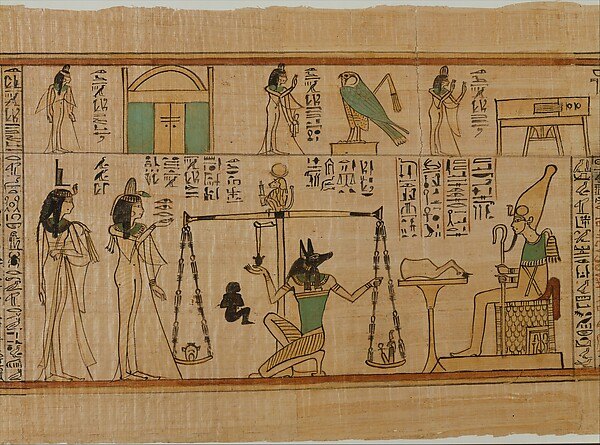
The New Kingdom saw the Book of the Dead develop and spread further. The famous Spell 125, the 'Weighing of the Heart', is first known from the reign of Hatshepsut and Thutmose III, . From this period onward the Book of the Dead was typically written on a papyrus scroll, and the text illustrated with vignettes. During the 19th Dynasty in particular, the vignettes tended to be lavish, sometimes at the expense of the surrounding text.
In the Third Intermediate Period, the Book of the Dead started to appear in hieratic script, as well as in the traditional hieroglyphics. The hieratic scrolls were a cheaper version, lacking illustration apart from a single vignette at the beginning, and were produced on smaller papyri. At the same time, many burials used additional funerary texts, for instance the Amduat.
During the 25th and 26th Dynasties, the Book of the Dead was updated, revised and standardized. Spells were ordered and numbered consistently for the first time. This standardized version is known today as the 'Saite recension', after the Saite (26th) Dynasty. In the Late period and Ptolemaic period, the Book of the Dead continued to be based on the Saite recension, though increasingly abbreviated towards the end of the Ptolemaic period. New funerary texts appeared, including the Book of Breathing and Book of Traversing Eternity. The last use of the Book of the Dead was in the 1st century BC, though some artistic motifs drawn from it were still in use in Roman times.
Spells
The Book of the Dead is made up of a number of individual texts and their accompanying illustrations. Most sub-texts begin with the word r(ꜣ), which can mean "mouth", "speech", "spell", "utterance", "incantation", or "chapter of a book". This ambiguity reflects the similarity in Egyptian thought between ritual speech and magical power. In the context of the Book of the Dead, it is typically translated as either chapter or spell. In this article, the word spell is used.
At present, some 192 spells are known, though no single manuscript contains them all. They served a range of purposes. Some are intended to give the deceased mystical knowledge in the afterlife, or perhaps to identify them with the gods: for instance, Spell 17 is an obscure and lengthy description of the god Atum. Others are incantations to ensure the different elements of the dead person's being were preserved and reunited, and to give the deceased control over the world around him. Still others protect the deceased from various hostile forces or guide him through the underworld past various obstacles. Famously, two spells also deal with the judgment of the deceased in the Weighing of the Heart ritual.
The texts and images of the Book of the Dead were magical as well as religious. Magic was as legitimate an activity as praying to the gods, even when the magic was aimed at controlling the gods themselves. Indeed, there was little distinction for the Ancient Egyptians between magical and religious practice. The concept of magic (heka) was also intimately linked with the spoken and written word. The act of speaking a ritual formula was an act of creation; there is a sense in which action and speech were one and the same thing. The magical power of words extended to the written word. Hieroglyphic script was held to have been invented by the god Thoth, and the hieroglyphs themselves were powerful. Written words conveyed the full force of a spell. This was even true when the text was abbreviated or omitted, as often occurred in later Book of the Dead scrolls, particularly if the accompanying images were present. The Egyptians also believed that knowing the name of something gave power over it; thus, the Book of the Dead equips its owner with the mystical names of many of the entities he would encounter in the afterlife, giving him power over them.
The spells of the Book of the Dead made use of several magical techniques which can also be seen in other areas of Egyptian life. A number of spells are for magical amulets, which would protect the deceased from harm. In addition to being represented on a Book of the Dead papyrus, these spells appeared on amulets wound into the wrappings of a mummy. Everyday magic made use of amulets in huge numbers. Other items in direct contact with the body in the tomb, such as headrests, were also considered to have amuletic value. A number of spells also refer to Egyptian beliefs about the magical healing power of saliva.
Organization
Almost every Book of the Dead was unique, containing a different mixture of spells drawn from the corpus of texts available. For most of the history of the Book of the Dead there was no defined order or structure. In fact, until Paul Barguet's 1967 "pioneering study" of common themes between texts, Egyptologists concluded there was no internal structure at all. It is only from the Saite period (26th Dynasty) onwards that there is a defined order.
Background reading selected and abridged from Book of the Dead by Wikipedia contributors (November 2023 edition), under CC BY-SA 4.0. The linked histories identify contributing authors.