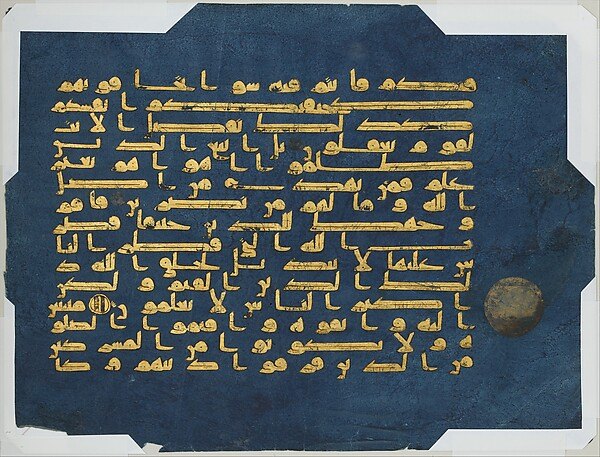
Calligraphy is a visual art related to writing.
Calligraphy
Calligraphy is a visual art related to writing. It is the design and execution of lettering with a pen, ink brush, or other writing instrument. Contemporary calligraphic practice can be defined as "the art of giving form to signs in an expressive, harmonious, and skillful manner".
Modern calligraphy ranges from functional inscriptions and designs to fine-art pieces where the letters may or may not be readable. Classical calligraphy differs from type design and non-classical hand-lettering, though a calligrapher may practice both.
Calligraphy continues to flourish in the forms of wedding invitations and event invitations, font design and typography, original hand-lettered logo design, religious art, announcements, graphic design and commissioned calligraphic art, cut stone inscriptions, and memorial documents. It is also used for props, moving images for film and television, testimonials, birth and death certificates, maps, and other written works.
Pens and brushes
The principal tools for a calligrapher are the pen and the brush. The pens used in calligraphy can have nibs that may be flat, round, or pointed. For some decorative purposes, multi-nibbed pens (steel brushes) can be used. However, works have also been created with felt-tip and ballpoint pens, although these works do not employ angled lines. There are some styles of calligraphy, such as Gothic script, that require a stub nib pen.
Inks, papers, and templates
The ink used for writing is usually water-based and is much less viscous than the oil-based ink used in printing. Certain specialty paper with high ink absorption and constant texture enables cleaner lines, although parchment or vellum is often used, as a knife can be used to erase imperfections and a light-box is not needed to allow lines to pass through it. Normally, light boxes and templates are used to achieve straight lines without pencil markings detracting from the work. Ruled paper, either for a light box or direct use, is most often ruled every quarter or half an inch, although inch spaces are occasionally used. This is the case with (hence the name), and college-ruled paper often acts as a guideline well.
East Asia
Chinese calligraphy is locally called or ( or in traditional Chinese, literally "the method or law of writing"); Japanese calligraphy is (, literally "the way or principle of writing"); and Korean calligraphy is called (/, literally "the art of writing"); The calligraphy of East Asian characters continues to form an important and appreciated constituent of contemporary traditional East Asian culture.
History
In ancient China, the oldest known Chinese characters are oracle bone script , carved on ox scapulae and tortoise plastrons, because the rulers in the Shang dynasty carved pits on such animals' bones and then baked them to gain auspice of military affairs, agricultural harvest, or even procreating and weather. During the divination ceremony, after the cracks were made, the characters were written with a brush on the shell or bone to be later carved. With the development of the bronzeware script and large seal script "cursive" signs continued. Mao Gong Ding is one of the most famous and typical bronzeware scripts in Chinese calligraphic history. It has 500 characters on the bronze which is the largest number of bronze inscription we have discovered so far. Moreover, each archaic kingdom of current China had its own set of characters.
In Imperial China, the graphs on old steles some dating from 200 BCE, and in the small seal script stylehave been preserved and can be viewed even today.
About 220 BCE, the emperor Qin Shi Huang, the first to conquer the entire Chinese basin, imposed several reforms, among them Li Si's character unification, which created a set of 3300 standardized small seal characters. Despite the fact that the main writing implement of the time was already the brush, few papers survive from this period, and the main examples of this style are on steles.
Between clerical script and traditional regular script, there is another transitional type of calligraphic work called Wei Bei. It started during the North and South dynasties (420 to 589 CE) and ended before the Tang dynasty (618–907).
The traditional regular script , still in use today, and attributed to Wang Xizhi (, 303–361) and his followers, is even more regularized. Its spread was encouraged by Emperor Mingzong of Later Tang (926–933), who ordered the printing of the classics using new wooden blocks in kaishu. Printing technologies here allowed a shape stabilization. The kaishu shape of characters 1000 years ago was mostly similar to that at the end of Imperial China. However, small changes have been made, for example in the shape of which is not absolutely the same in the Kangxi Dictionary of 1716 as in modern books. The Kangxi and current shapes have tiny differences, while stroke order is still the same, according to the old style.
Styles which did not survive include , a mix of 80% small seal script and 20% clerical script. Some variant Chinese characters were unorthodox or locally used for centuries. They were generally understood but always rejected in official texts. Some of these unorthodox variants, in addition to some newly created characters, compose the simplified Chinese character set.
Background reading selected and abridged from Calligraphy by Wikipedia contributors (November 2023 edition), under CC BY-SA 4.0. The linked histories identify contributing authors.