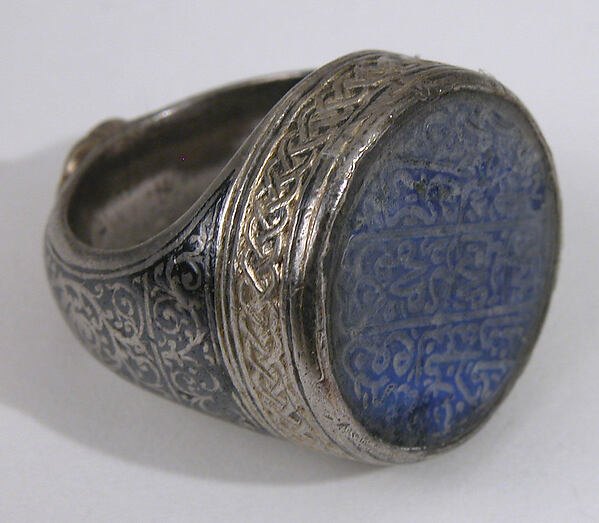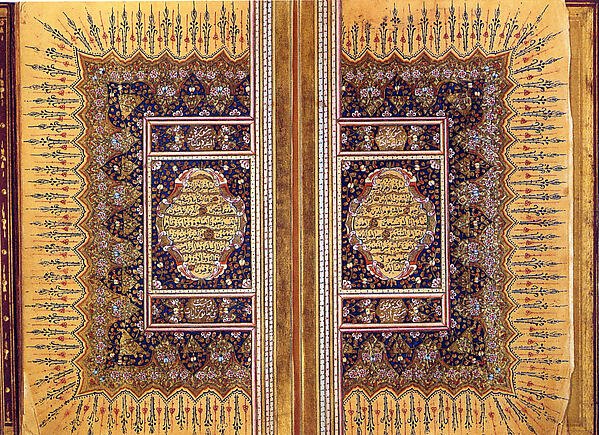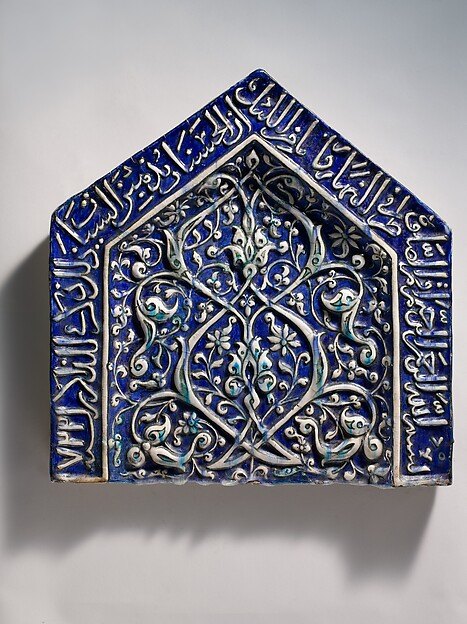
There was no set rules of using the Kufic script; the only common feature is the angular, linear shapes of the characters.
Islamic calligraphy
Kufic
There was no set rules of using the Kufic script; the only common feature is the angular, linear shapes of the characters. Due to the lack of standardization of early Kufic, the script differs widely between regions, ranging from very square and rigid forms to flowery and decorative ones.
Decorative Kufic inscriptions are often imitated into pseudo-kufics in Middle age and Renaissance Europe. Pseudo-kufics is especially common in Renaissance depictions of people from the Holy Land. The exact reason for the incorporation of pseudo-Kufic is unclear. It seems that Westerners mistakenly associated 13th-14th century Middle Eastern scripts with systems of writing used during the time of Jesus, and thus found it natural to represent early Christians in association with them.
Naskh
The use of cursive scripts coexisted with Kufic, and historically cursive was commonly used for informal purposes. Naskh first appeared within the first century of the Islamic calendar. Naskh translates to "copying", as it became the standard for transcribing books and manuscripts. The script is the most ubiquitous among other styles, used in the Qur'an, official decrees, and private correspondence. It became the basis of modern Arabic print.
Kufic is commonly believed to predate naskh, but historians have traced the two scripts as coexisting long before their codification by ibn Muqla, as the two served different purposes. Kufi was used primarily in decoration, while Naskh served for everyday scribal use.
Thuluth
Thuluth was developed during the 15th century and slowly refined by Ottoman Calligraphers including Mustafa Râkim, Shaykh Hamdallah, and others, till it became what it is today. Letters in this script have long vertical lines with broad spacing. The name, meaning "one third", may possibly be a reference to the x-height, which is one-third of the 'alif, or to the fact that the pen used to write the vowels and ornaments is one third the width of that used in writing the letters.
Reqāʿ
Reqāʿ is a handwriting style similar to thuluth. It first appeared in the 10th century. The shape is simple with short strokes and small flourishes. Yaqut al-Musta'simi was one of the calligraphers who employed this style. The Arab, Ibn al-Bawwab is actually believed to have created this script.
Muhaqqaq
Muhaqqaq is a majestic style used by accomplished calligraphers, and is a variation of thuluth. Along with thuluth, it was considered one of the most beautiful scripts, as well as one of the most difficult to execute. Muhaqqaq was commonly used during the Mamluk era, but its use became largely restricted to short phrases, such as the basmallah, from the 18th century onward.
Regional styles
With the spread of Islam, the Arabic script was established in a vast geographic area with many regions developing their own unique style. From the 14th century onward, other cursive styles began to develop in Turkey, Persia, and China.
Maghrebi scripts developed from Kufic letters in the Maghreb (North Africa) and al-Andalus (Iberia), Maghrebi scripts are traditionally written with a pointed tip (القلم المذبب), producing a line of even thickness. Within the Maghrebi family, there are different styles including the cursive mujawher and the ceremonial mabsut.
Diwani is a cursive style of Arabic calligraphy developed during the reign of the early Ottoman Turks in the 16th and early 17th centuries. It was invented by Housam Roumi, and reached its height of popularity under Süleyman I the Magnificent (1520–1566). Spaces between letters are often narrow, and lines ascend upwards from right to left. Larger variations called djali are filled with dense decorations of dots and diacritical marks in the space between, giving it a compact appearance. Diwani is difficult to read and write due to its heavy stylization and became the ideal script for writing court documents as it ensured confidentiality and prevented forgery.
Nasta'liq is a cursive style originally devised to write the Persian language for literary and non-Qur'anic works. Nasta'liq is thought to be a later development of the naskh and the earlier ta'liq script used in Iran. Quite rapidly gaining popularity as a script in South Asia. The name ta'liq means "hanging," and refers to the slightly sloped quality of lines of text in this script. Letters have short vertical strokes with broad and sweeping horizontal strokes. The shapes are deep, hook-like, and have high contrast. A variant called Shikasteh was developed in the 17th century for more formal contexts.
Sini is a style developed in China. The shape is greatly influenced by Chinese calligraphy, using a horsehair brush instead of the standard reed pen. A famous modern calligrapher in this tradition is Hajji Noor Deen Mi Guangjiang.
Modern
In the post-colonial era, artists working in North Africa and the Middle East transformed Arabic calligraphy into a modern art movement, known as the Hurufiyya movement. Artists working in this style use calligraphy as a graphic element within contemporary artwork.
The term, hurufiyya is derived from the Arabic term, harf for letter. Traditionally, the term was charged with Sufi intellectual and esoteric meaning. It is an explicit reference to a medieval system of teaching involving political theology and lettrism. In this theology, letters were seen as primordial signifiers and manipulators of the cosmos.
Background reading selected and abridged from Islamic calligraphy by Wikipedia contributors (November 2023 edition), under CC BY-SA 4.0. The linked histories identify contributing authors.